

Branding Design, Performance Marketing
Brandformance: balancing brand building and driving results
Business Hub in ChatGPT: what changes for brands
When someone searches for a company, product or service in ChatGPT, the answer can influence a decision before they even visit a website.
Until now, brands had little direct control over how their information was presented in this context.
Business Hub is starting to change that.
Launched in beta by OpenAI, Business Hub allows companies to claim their profile in ChatGPT, update information and better understand how they are being discovered within the platform.
For brands, the key change is not simply having another profile to manage.
It is having a dedicated space within ChatGPT where they can monitor and manage how the business is represented.
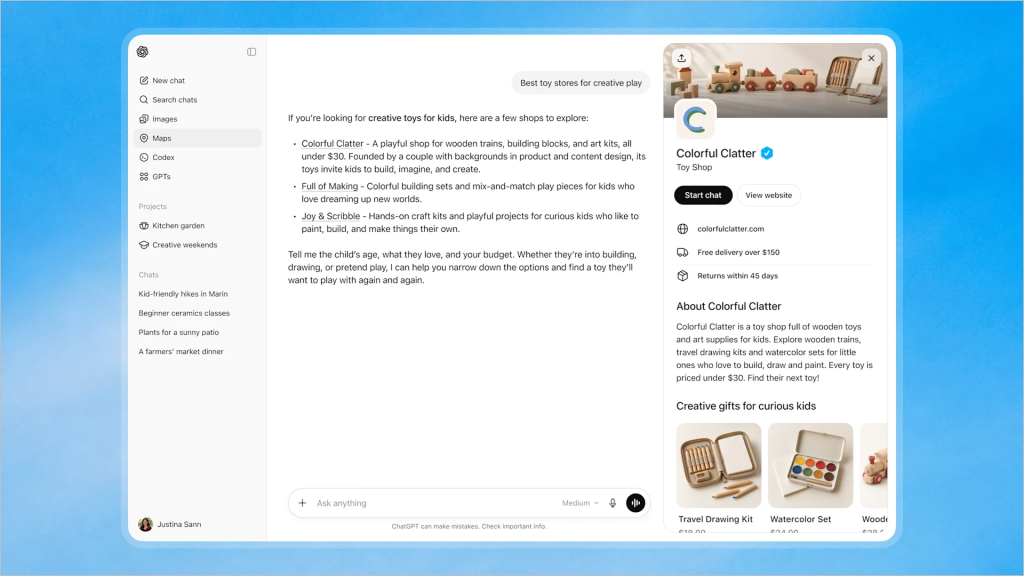
What exactly is Business Hub?
Business Hub is an area within ChatGPT designed for businesses and authorised representatives.
Once a business has been claimed and verified, it is possible to manage information such as the website, business description, product or service category, logo and certain company policies. Photos and other relevant information can also be added.
For businesses that sell products, there is also the option to connect a product feed, including information such as prices and availability.
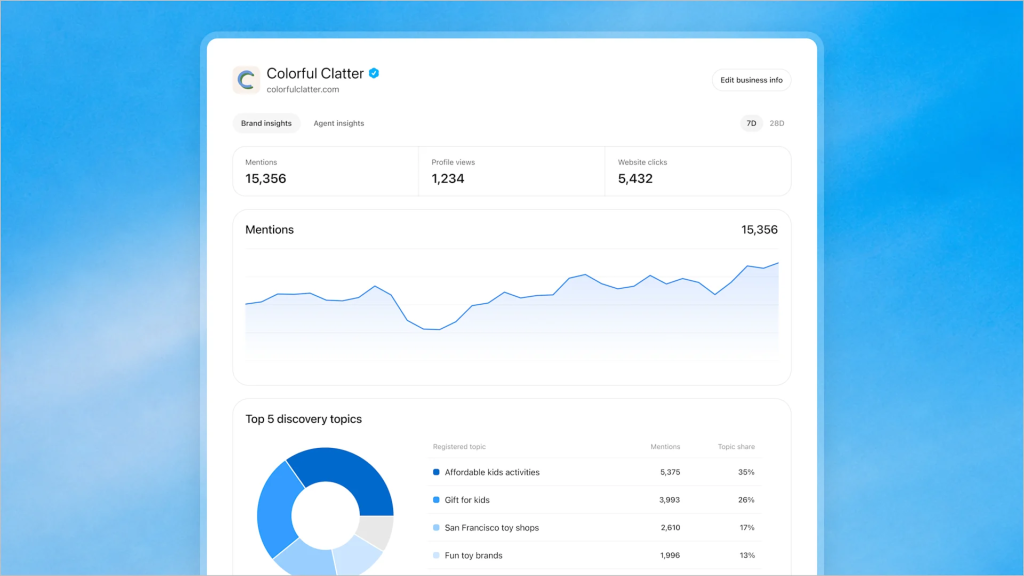
But perhaps one of the most interesting features for marketing teams is Insights.
Business Hub provides access to aggregated data on:
- company mentions;
- website clicks;
- discovery topics associated with responses in which the company appears.
In other words, there is now a new way to understand how a brand is appearing in conversations and answers generated within ChatGPT.
Claiming a business is more than creating a profile
The process is not as simple as opening a new page on a social network.
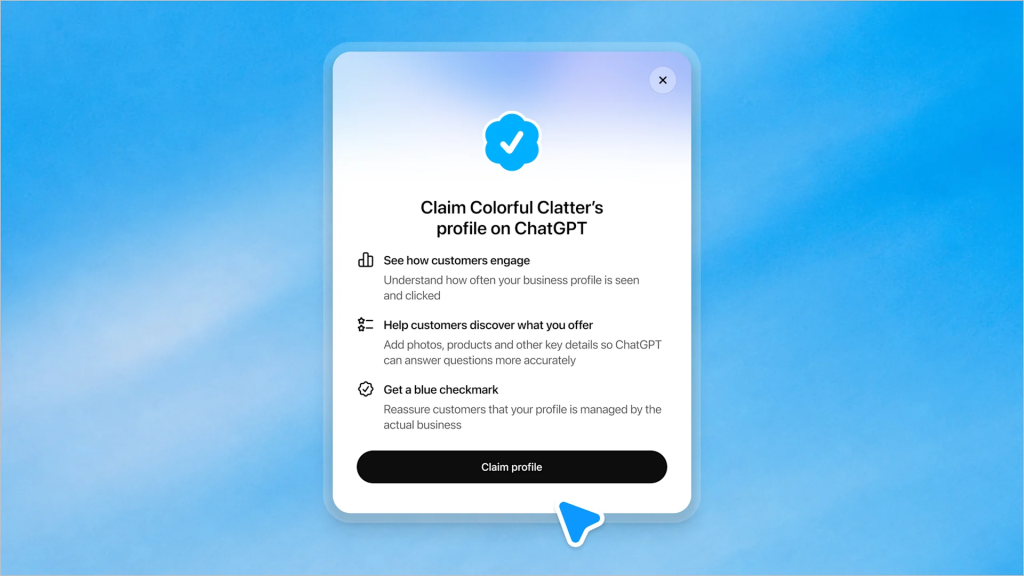
To manage a business in Business Hub, it is necessary to demonstrate a legitimate connection to the company.
Depending on the profile, verification can be completed through methods such as a business email address, phone number, website domain or Shopify. Once the business has been claimed, identity verification through Persona is also required to access certain features, such as publishing changes, viewing insights or connecting a product feed.
Once this process is complete, the profile may display a verified business badge.
This is relevant because it introduces an important distinction between information about a company that exists online and information provided and managed directly by the company itself.
For brands, this creates an additional responsibility: ensuring that the information provided is accurate, up to date and aligned with what the business actually offers.
More control over the information. Not over the answers.
This is perhaps the most important point about this new feature.
Claiming a business in Business Hub does not mean controlling what ChatGPT says about the brand.
Nor does it guarantee that the company will appear more often or receive preferential placement.
OpenAI itself clarifies that claiming a business allows companies to manage the information they provide, but does not give them direct control over ChatGPT’s independent recommendations. The platform may still draw on other sources when answering questions about a business.
In other words, Business Hub should not be seen as a kind of “shortcut” to achieving greater visibility in responses.
Its value lies elsewhere.
It allows brands to reduce the gap between the information they want to communicate and the information available for use within the platform.
And that makes consistency even more important.
If the website says one thing, the business profile says another and external sources contain outdated information, there is still noise.
Having more control over one source does not remove the need to build a coherent digital presence.
Understanding how the brand is being discovered
Until now, much of digital presence measurement has relied on relatively familiar metrics.
- Traffic.
- Impressions.
- Clicks.
- Google rankings.
- Conversions.
Business Hub adds another layer.
Through Insights, businesses can view aggregated activity from the previous 28 days, including mentions and website clicks. There are also discovery topics, which group together common themes found in responses where the company has been mentioned or cited.
For a marketing team, this can help answer a different set of questions:
- In what contexts is our brand appearing?
- What topics are being associated with the company?
- Are people reaching our website through these responses?
There is, however, an important limitation.
Businesses do not receive access to individual user questions or conversations. The topics shown are aggregated and do not directly represent each person’s individual intent.
Even so, this is a significant change.
Because a brand’s presence in ChatGPT is starting to become less invisible to the people managing it.
For e-commerce, product information becomes even more important
For businesses selling online, Business Hub introduces another possibility: connecting structured product information.
Feeds can include data such as products, prices and availability, helping keep the catalogue more up to date within this ecosystem.
This reinforces something that is already important in e-commerce, regardless of the channel:
The quality of product information influences a platform’s ability to understand what is being sold.
- Clear titles.
- Useful descriptions.
- Accurate prices.
- Up-to-date availability.
- Well-defined categories.
All of this is no longer simply a matter of internal catalogue organisation.
It also becomes part of how products can be understood and presented in new discovery contexts.
However, expectations need to remain realistic: connecting a feed does not guarantee that a product will be recommended by ChatGPT.
Business Agents: when the company enters the conversation
Business Hub also introduces another dimension: Business Agents.
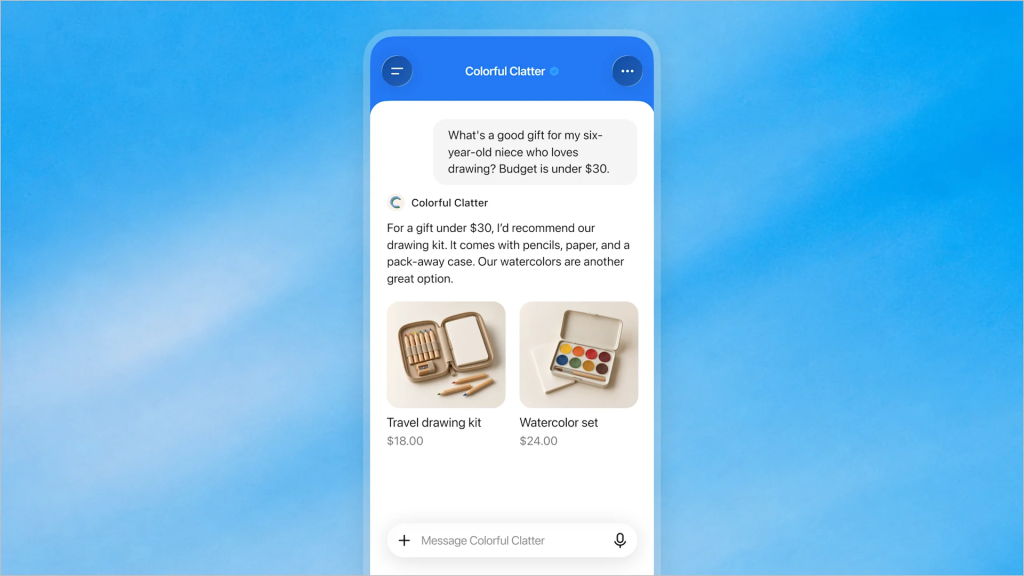
Unlike general ChatGPT responses, a Business Agent directly represents a company and responds based on the information, products, policies and guidance provided by that organisation.
In practice, a user can start a dedicated conversation with the business to clarify questions about products or policies before taking the next step.
At the moment, this feature is limited to eligible e-commerce and online service businesses in the United States that meet specific website and eligibility requirements.
It is also important to distinguish what these agents can currently do.
They can help explain products and policies and direct users to the website, but they do not yet carry out actions such as completing purchases, making reservations or checking orders directly.
In other words, the Business Agent works primarily as a new layer of information and decision support, rather than a replacement for the entire commercial process.
What should brands start doing?
Business Hub is still at an early stage, and availability depends on the type of business, location and supported verification methods.
But there are a few things brands can start doing now.
1. Check whether the business can already be claimed
The first step is to find out whether a business profile already exists in Business Hub and whether the necessary verification methods are available.
Whenever possible, this management should be assigned to someone formally authorised to represent the business.
2. Review the brand’s essential information
- Website.
- Description.
- Category.
- Services.
- Logo.
- Policies.
Basic information may seem simple, but this is precisely where many inconsistencies appear.
It is worth making sure that what is communicated in Business Hub reflects the current reality of the business.
3. Ensure consistency across other channels
Managing a presence in ChatGPT does not replace the website, SEO, social media, public relations or other touchpoints.
Business Hub simply adds another point to the ecosystem.
The more consistent the information is across platforms, the clearer the brand’s overall representation becomes.
4. For e-commerce, treat the catalogue as content
A feed should not be seen simply as a technical file.
Product information is communication.
The clearer, more accurate and more complete it is, the easier it becomes to understand what each product is, who it is for and in what context it is relevant.
5. Track the new data in context
Mentions or clicks on their own say very little.
The real value lies in monitoring how these metrics evolve over time and understanding which topics the brand is beginning to appear in.
Rather than simply looking for large numbers, it will be important to understand whether the company is being associated with the topics in which it genuinely wants to build authority.
Digital presence is also starting to be managed within AI platforms
Business Hub represents an interesting shift in the relationship between businesses and artificial intelligence platforms.
Until now, much of the focus for brands was on ensuring that accurate information existed on their website and across different digital channels.
That remains essential.
But a new layer is beginning to emerge: directly managing the company’s presence within the platforms where people search, compare and make decisions.
Business Hub does not guarantee visibility.
It does not control recommendations.
And it does not replace a consistent digital strategy.
But it gives brands a new way to influence how their information is presented, monitor some signals of discovery and keep important business information more up to date.
Because as discovery channels evolve, the way brands manage their presence needs to evolve with them.


